
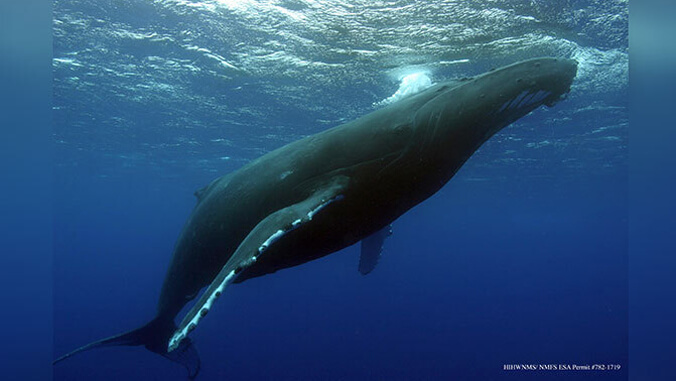
Humpback whales might at some point keep away from Hawaiian waters as a result of local weather change and rising greenhouse gasses, in accordance the findings of a new paper printed in Frontiers in Marine Science by a staff of researchers together with three College of Hawaiʻi at Mānoa graduate college students—Hannah von Hammerstein and Renee Setter from the Department of Geography and Environment within the College of Social Sciences, and Martin van Aswegen from the Marine Mammal Research Program within the Institute for Marine Biology.
Humpback whales are identified emigrate towards tropical coastal waters, comparable to Hawaiʻi’s, the place they offer start to their calves. These areas lay in areas with sea floor temperatures ranging between 21 and 28 levels Celsius (roughly 70–82 levels Fahrenheit), and the whales sometimes return to the identical websites yearly.
Based on von Hammerstein, Setter, van Aswegen and co-researchers from the Pacific Whale Basis, anthropogenic local weather change is warming the oceans at unprecedented charges. On the present tempo, it’s probably that a few of these breeding grounds will warmth up previous the 21–28℃ temperature vary over the following century.
Utilizing a statistical “delta downscaling” technique to extend the decision of worldwide sea floor temperatures and monitor the important 21–28℃ isotherms (strains drawn on a map or chart becoming a member of factors with the identical temperature) that border humpback whale breeding grounds all through the twenty first century, analysis suggests two doable local weather change situations:
- By 2100, in a worst case state of affairs with persevering with excessive growth and unabated carbon emissions, 67% of humpback whale breeding grounds will surpass the important sea floor temperature of 28℃.
- In a “middle-of-the-road” state of affairs with international and worldwide establishments working towards emission mitigation targets, that quantity would fall to 35% of breeding grounds.
“We anticipated to see important warming in a few of the breeding grounds, however the variety of critically affected areas was a shock,” stated von Hammerstein. “Whereas the outcomes of the examine are daunting, additionally they spotlight the variations between the 2 emission situations and what nonetheless could be gained by implementing emission mitigation measures.”
Setter added, “It’s actually essential that we attempt to scale back our greenhouse fuel emissions and actually attempt to keep on that ‘middle-of-the-road’ greenhouse fuel emissions state of affairs on the very least, simply in order that we are able to save as a lot of these breeding grounds as doable from surpassing that important temperature threshold.”
The researchers observe that, whereas it’s at the moment not identified whether or not humpback whales will proceed emigrate to breeding grounds above 28°℃, they hope their findings could also be an incentive for policymakers to work towards decreasing emissions, not solely in Hawaiʻi but in addition on a world stage.
“Our findings present yet one more instance of what’s to come back with anthropogenic local weather change, with humpback whales representing merely one impacted species,” van Aswegen stated. “Enhancing our understanding of how ecosystems are going to vary is important for the efficient and well timed implementation of mitigative measures.”
from Other News – My Blog https://ift.tt/YCK58Me
via IFTTT

No comments:
Post a Comment