
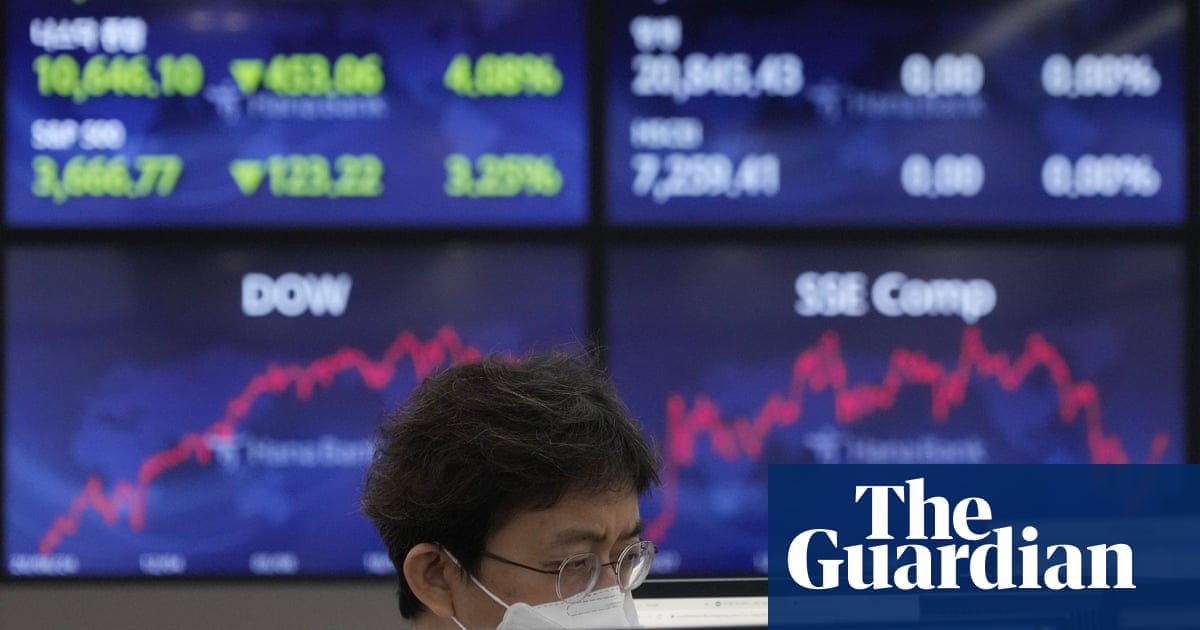
The worldwide rout in inventory markets, cryptocurrencies and different dangerous property has gathered tempo amid rising concern that out-of-control inflation, rising rates of interest and slowing progress might mix to tip the world into recession.
Share costs fell in Asia on Friday at the start of what was more likely to be one other torrid day for buyers spooked by the US Federal Reserve’s determination this week to raise interest rates by the largest margin for almost 30 years.
Different main central banks such because the Financial institution of England and the Swiss Nationwide Financial institution have adopted go well with – the latter in its first hike for 15 years – sending economists scrambling to revise their forecast for progress downwards.
Stephen Innes at SPI Asset Administration in Hong Kong mentioned: “No central bankers value their weight would put inflation-fighting credentials on the road and import increased power inflation by way of a weaker foreign money.
Regardless of the Financial institution of Japan saying on Friday that it was sticking to its ultra-loose financial coverage, he added the speed rises eleswhere had been a “extremely ominous sign for inventory market buyers… the worldwide race to hike charges is nowhere close to the ending line”.
Many imagine that america could also be in recession by subsequent 12 months, elevating the prospect of a wider world droop.
Shares on the earth’s largest economic system have suffered their worst begin to a 12 months for 60 years with the S&P 500 benchmark index down 23% since January after shedding one other 3.25% on Thursday. Analysts at JP Morgan mentioned the state of the S&P 500 “implies an 85% chance of a US recession”.
The falls – mirrored on the Dow Jones common, the tech-heavy Nasdaq and UK and European markets – did nothing to spice up confidence in Asia Pacific. The Nikkei in Tokyo was off 1.65% and was on observe for its worst week of losses for 2 years, as was India’s principal Nifty index. In Sydney, the ASX200 was down 2% on Friday afternoon.
The cryptocurrency rout additionally exhibits no signal of abating with bitcoin down 7.8% and ethereum 8.45% worse off. As well as, the Monetary Instances reported that the Singapore-based crypto hedge fund Three Arrows Capital – which has $10bn below administration – failed to fulfill margin calls this week amid the slide in crypto values.
The outlook is worsened by the chance of the battle in Ukraine dragging on and the west’s financial struggle on Russia resulting in even increased power costs forward of the northern hemisphere winter.
“The velocity and diploma of coverage tightening might show an excessive amount of for economies to deal with, notably given the commodity worth shock at the moment in play,” economists at NAB financial institution in Australia mentioned in a notice on Friday. “In consequence, recession threat for a number of of the key superior economies, together with the US, is uncomfortably excessive.”
David Bassanese, chief economist of Betashares in Sydney, went additional and predicted a US recession “inside the subsequent 12 months” resulting from persistent inflation and the Fed’s pledge to lift charges till the inflation genie is again within the bottle.
In consequence, he mentioned that share markets within the US had additional to fall. “There appears scope for fairness markets to fall additional. My base case is the final word peak-to-trough decline within the S&P 500 can be 35%, implying a decline to three,100 from its closing peak of 4,796 on 3 January.” It closed at 3,667 factors on Thursday.
The continued coronavirus lockdowns in China are inflicting additional issues for the worldwide economic system. Provide chain snarl-ups on the earth’s second largest economic system that began throughout the pandemic are predicted to proceed into subsequent 12 months no less than due to the shutdown of Shanghai and different key areas.
The larger image is that China was already going through issues starting from the decoupling from the west amid geopolitical tensions, a faltering, vastly indebted property market, and the uncertainty brought on by president Xi Jinping’s crackdown on massive tech firms.
Because the west will increase charges, China’s central financial institution has been cutting them and the federal government in Beijing has been throwing extra stimulus on the economic system. It helped mainland shares and the Hong Kong market buck the downward development in Friday’s buying and selling, however is probably not sufficient to refloat the worldwide economic system as its huge $4tn stimulus did after the worldwide monetary disaster of 2008-09.
The Financial institution of England’s determination to lift charges by 0.25% on Thursday was criticised by some as too little too late to cease inflation in its tracks. One forecast says costs can be rising by 11% by October and one other report mentioned meals worth rises could top 15% within the autumn.
The British economic system shrank by 0.3% in Could, based on figures launched on Monday, and after a 0.1% decline it “increased” the chances that the economy will slip into recession, based on Paul Dales, the chief economist on the consultancy Capital Economics.
The eurozone can be limping badly and is riven by doubts over easy methods to take care of the diverging real borrowing costs between completely different international locations which imply Italy has to pay greater than Germany regardless of having the identical foreign money.
The Economist Intelligence Unit (EIU) says in a report that though the US rebounded from the pandemic droop extra shortly than different economies, there have been indicators that shopper spending was weakening. Its base view is that US progress will cease in need of a recession, nevertheless it might be a detailed name.
“EIU’s core forecast is that financial progress within the US will sluggish sharply over the course of 2022 and 2023, owing to stubbornly excessive inflation, rising rates of interest and stalling progress elsewhere,” it mentioned.
“We anticipate shopper demand to be resilient sufficient to keep away from an outright recession, thanks partly to the tight labour market and robust family stability sheets. Nevertheless, this doesn’t imply {that a} recession is totally off the playing cards.”

No comments:
Post a Comment